
Caregiver Jobs: Where the Real Openings Are (and How to Get Them)
The real caregiver openings sit in three places: home care agencies, which post the bulk of steady work; families hiring directly, who pay the best rates because no agency margin comes out of them; and niche boards that collect one kind of job — live-in — instead of every shift under the sun. General job boards have the most listings and the worst signal. Knowing which channel fits the work you want is most of the job search.
Where caregiver jobs actually get posted
Agencies are the biggest source of steady work. An agency holds the contract with the family and staffs the case, and cases turn over constantly — a client recovers, moves to a facility, or passes away, and the agency needs the next caregiver. That churn is why agencies recruit year-round and why applying directly to agencies, instead of waiting for their ads, puts you in front of openings that never reach a public board.
General job boards aggregate everything, and it shows. They are fine for hourly shifts near home. But their listings are formatted for hourly work, so a live-in case paying a day rate sits mixed in with part-time companionship shifts, with no clean way to filter for it — and postings linger long after the case is filled. You get volume, not signal.
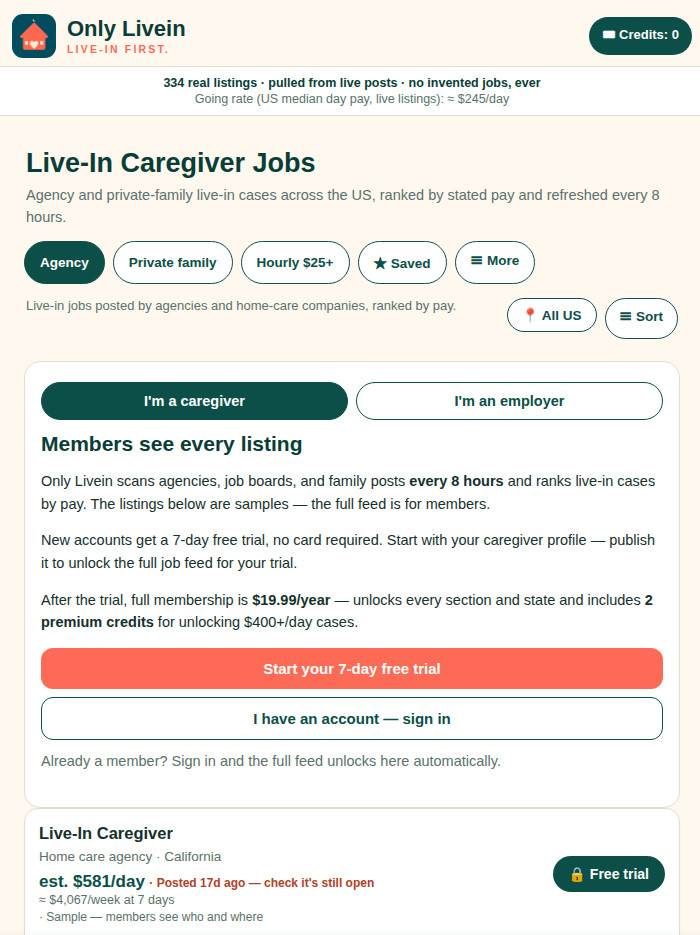
Niche boards collect one job type, deeply. Only Livein scans agencies, job boards, and family posts every 8 hours and keeps only live-in caregiver jobs, ranked by pay — the feed is live-in only, nothing else. The live case tracker shows where cases are open by state, so you can see the market instead of guessing at it.
Families post cases themselves, too. Family-posted cases usually pay the full day rate — there is no agency margin in between — and in exchange families screen harder: references they can call, a background check, a real conversation about the care involved. Caregivers who show up ready for that screening win these cases.
And a quiet fourth channel: referrals. A large share of live-in placements are never posted anywhere — a family asks the caregiver who is leaving, an agency calls someone who worked a similar case, a departing caregiver hands the family a name. You cannot apply to the referral channel, but you can earn your way into it: finish cases well, stay reachable between them, and make sure every agency and family you have worked for knows when you are free. The caregivers who never seem to look for work are the ones this channel feeds.
Why "caregiver jobs near me" is the wrong search for live-in work
Hourly caregiving is a commute, so it is local by definition. Live-in work is not: you move into the home for the rotation, so families hire from a much wider radius, and a strong case is worth travelling for. A zip-code search throws away most of the market before you have seen it. Search by pay and case fit first — day rate, care type, rotation — then decide whether the location works for you. The state counts on the tracker show where live-in demand actually concentrates, which is often not the metro you started in.
Travelling for a case is less disruptive than it sounds, because the job comes with a room. You are not renting in a new city or commuting across it — you live where you work for the rotation, then go home on your days off. That is exactly why families can hire from further away, and why experienced live-in caregivers treat their market as a region, or the whole country, rather than a zip code. The caregivers who insist on staying within one metro are competing for a fraction of the cases at whatever rate that metro happens to pay.
What the pay looks like before you apply
Live-in caregivers are usually paid a day rate, not an hourly wage. Across current US listings, stated day rates cluster at $200–$350/day, with a median of about $245/day (Only Livein Pay Index, October 2026, N=22). At the median, a 7-day week is about $1,715 before days off. Cases at $400/day and up are the premium end — real, but rare, and a genuine premium case can always name the employer, the city, and the start date. The full breakdown, including how rotations change the weekly math, is in our live-in caregiver pay guide.
How to get the good cases first
- Be specific about experience. "Dementia care, two-person transfers, hospice support" gets hired. "Caregiving" does not. Name the conditions you have actually worked.
- Have references that answer the phone. Families call. Tell your references a call is coming, and use people who supervised or received your care.
- Offer the background check before you are asked. It removes the family's biggest unknown in one step.
- Be flexible on rotations and start dates. Four-on/three-off, weekend relief, a start this week — flexibility is what urgent, better-paying cases are buying.
- Keep a complete profile. Caregivers publish profiles in the Only Livein directory — experience, specialties, availability — and families browse it. A finished profile works while you sleep.
- Move fast. Good cases fill in days, not weeks. Checking a feed that refreshes every 8 hours beats refreshing five boards once a week.
Coming from a generalist marketplace? We compared the realistic options in Care.com alternatives for caregivers. Weighing agency work against family-direct cases? Start with agencies vs. hiring directly.
See every current case. Start with a 7-day free trial — the full listings and your own caregiver profile, no card required. Members (then $19.99/year) see the full listings — who is hiring, the exact city, and the apply link — refreshed every 8 hours. Browse the current cases.
More live-in guides and job pages
All articles — the Only Livein blog · Caregiver jobs: where the openings are · Care.com alternatives for caregivers · The Care.com alternative for live-in care · How to find a live-in caregiver · Agencies vs. hiring directly · Live-in caregiver pay in 2026 · Live-in home care: costs and hiring · Live case tracker · Browse the current cases